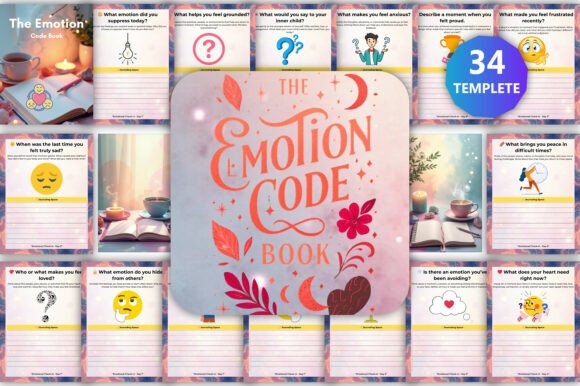
The Emotion Code Workbook Canva KDP
If you're exploring emotional healing tools that blend structure with personalization, The Emotion Code Workbook Canva KDP stands out—not as a static PDF alone, but as a flexible, creator-ready resource designed for both self-use and professional distribution. It’s built for people who want more than just journaling prompts: they want editable design control, print-and-go reliability, and the ability to adapt tone, branding, or layout without technical overhead. Whether you’re a wellness coach launching a digital product, a therapist adding client-facing tools, or someone beginning their own emotional awareness journey, this workbook bridges intention and execution.
What It Really Is—And What It’s Not
The Emotion Code Workbook Canva KDP is not simply a repackaged journal. It’s a dual-format offering: a polished, ready-to-upload PDF optimized for Amazon KDP (with proper bleed, margins, and CMYK-ready color), plus an editable Canva link that lets you revise fonts, colors, cover art, and even prompt wording before publishing or personalizing. That distinction matters—many buyers assume “editable” means full design freedom in any tool, only to discover later their version lacks layered text boxes, responsive spacing, or KDP-compliant formatting.
This workbook also isn’t a clinical treatment substitute. It supports self-reflection and gentle emotional release through guided writing—not diagnosis, trauma processing, or therapeutic intervention. Readers seeking deep psychological work should pair it with qualified support. But for consistent, low-barrier emotional check-ins? Its 30 daily prompts—covering joy, anxiety, gratitude, grief, and inner peace—are intentionally paced and non-prescriptive.
Common Missteps—and How They Slow Progress
Mistake #1: Assuming the Canva link works like a design template library. Some users expect drag-and-drop customization across all pages, only to find certain elements locked or grouped. The Canva file is optimized for clarity and printing—not infinite remixing. For example, headers and page numbers are often anchored to prevent misalignment during KDP export. If you change font sizes carelessly, line breaks shift, and text overflows into margins. The fix? Use Canva’s “break apart” function sparingly, preview each spread in desktop view, and always export a test PDF before uploading to KDP.
Mistake #2: Skipping the print-test phase. Because the workbook includes subtle watercolor textures and soft gradients, some users print on standard copy paper and wonder why colors look muted or lines blur. The PDF is designed for matte or premium uncoated paper (100–120 gsm), not glossy photo stock. A quick home-print test on your intended paper type reveals contrast issues early—saving time and cost when ordering bulk copies.
Mistake #3: Using the journal prompts linearly without pausing to integrate. The 30-day structure is helpful—but emotional awareness isn’t chronological. One user reported frustration after day 7 because “nothing felt released.” Later, she realized she’d rushed through the emotional release exercises instead of sitting with discomfort long enough to name it. Better approach? Treat each prompt as a conversation starter—not a checklist. Revisit earlier pages if a theme resurfaces. The journal’s power lies in repetition and resonance, not speed.
What to Verify Before You Buy—or Customize
Before purchasing or adapting The Emotion Code Workbook Canva KDP, check three practical things:
- File compatibility: Confirm the Canva link opens in your region and browser. Some educational institutions or corporate networks restrict external Canva access. Try opening it on mobile and desktop first.
- KDP readiness: Look for embedded crop marks, correct trim size (e.g., 6" x 9"), and no RGB-only images. The included PDF should pass KDP’s auto-checker without warnings about bleed or resolution.
- Usage rights clarity: The license covers personal use and commercial resale *as-is* or *customized*, but does not permit reselling the raw Canva link itself or claiming authorship of the original framework. If you plan to brand it under your studio name, edit the copyright page—not just the cover.
Better Ways to Use the Workbook—Beyond the Obvious
For creators: Instead of selling the workbook solo, bundle it with a 15-minute audio guide (“How to Begin Your Emotional Release Practice”) or a short Loom video walking through the first three prompts. That adds perceived value without extra design work—and reduces support questions about “where to start.”
For educators or team facilitators: Print only the mindset reset pages and reflection spaces for in-person workshops. Skip the full 30-day sequence—focus on one emotion per session (e.g., “Anger Mapping” or “Gratitude Anchors”). The prompts hold up well in bite-sized formats.
For individuals building consistency: Pair the journal with a simple habit stack. Example: After your morning tea, open to that day’s prompt and write for seven minutes—no editing, no rereading. Let the act of handwriting ground you before checking email or scrolling. The physicality matters; typing dilutes the somatic connection the workbook is built to nurture.
Why Format Choice Affects Real-World Results
The reason The Emotion Code Workbook Canva KDP includes both Canva access and a final PDF isn’t just convenience—it’s about matching format to function. Canva empowers adaptation: swap affirmations for your audience’s language, adjust spacing for dyslexic readability, or add your logo to every header. The PDF ensures fidelity: what you see is what prints, reliably, across devices and printers. Choosing one over the other based on need—not habit—keeps your workflow efficient and your output trustworthy.
That balance reflects the workbook’s deeper intent: emotional work requires both flexibility and stability. You need room to explore—and a container sturdy enough to hold what comes up. When your tool supports both, the practice becomes sustainable, not performative.
If you’ve tried journaling before and drifted away, this isn’t about adding another task. It’s about choosing a structure that adapts to *you*—not the other way around. With The Emotion Code Workbook Canva KDP, the design serves the process, not the reverse.