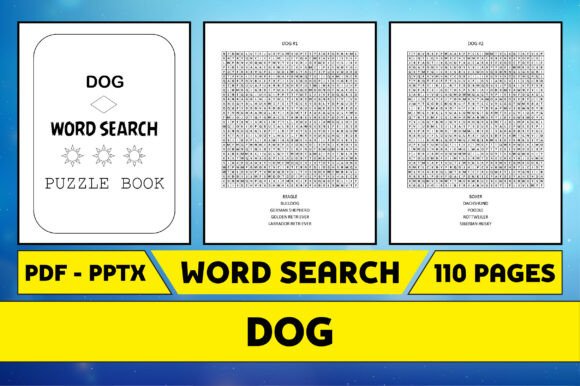
Dog Word Search Puzzle Game Interior
The Dog Word Search Puzzle Game Interior is a ready-to-use, print-optimized book interior designed specifically for puzzle enthusiasts, pet lovers, and self-publishing creators. It’s not a finished book or a marketing asset — it’s the functional, production-ready core: 110 pages of cleanly laid-out content built to meet industry standards for both physical and digital distribution. At its center are 50 original dog-themed word search puzzles — each on its own page — paired with 50 corresponding solution pages, also one per page. The layout follows an 8.5″ x 11″ trim size, uses high-contrast black-and-white formatting for clarity and cost-effective printing, and maintains consistent typography and spacing throughout.
What Sets This Interior Apart From Generic Puzzle Templates
Many puzzle interiors rely on automated generators or generic layouts that prioritize speed over usability. The Dog Word Search Puzzle Game Interior differs in three measurable ways: thematic cohesion, production readiness, and format flexibility. Unlike broad “animal” or “general vocabulary” word search collections, every puzzle centers on dog-related terms — breeds (e.g., Beagle, Poodle), behaviors (fetch, bark, wag), anatomy (tail, paw, muzzle), care concepts (leash, crate, vet), and even playful idioms (“raining cats and dogs”). This consistency supports audience targeting — especially for readers seeking niche appeal over mass-market neutrality.
Production readiness goes beyond aesthetics. Each puzzle is hand-placed with ample white space, clear grid boundaries, and legible fonts sized for adult readers (not children). There’s no overlapping text, inconsistent margins, or misaligned solutions. The interior includes front matter (title page, instructions), numbered puzzles and solutions, and a clean page count — all structured to pass Amazon KDP’s automated checks without manual reformatting. That’s not guaranteed with DIY templates or free Canva-based interiors, which often require hours of adjustment before upload.
How It Compares With Other Interior Options
When evaluating alternatives, creators typically consider four categories: fully custom-designed interiors, editable template kits (like those sold on Etsy or Creative Market), AI-generated PDFs, and prebuilt interiors bundled with cover design services. The Dog Word Search Puzzle Game Interior sits between templated and custom — offering specificity without requiring design expertise.
- Custom interiors offer full branding control and unique visual identity but demand time, budget, and design literacy. A professional designer may charge $300–$800 for a 110-page puzzle interior — a significant investment if the goal is rapid testing or low-risk publishing.
- Generic editable templates (often .PPTX or .INDD files) provide flexibility but lack subject-specific content. You’d still need to generate 50 puzzles, write clues, verify solutions, and ensure grid consistency — tasks that easily consume 15–20 hours for someone unfamiliar with word search construction logic.
- AI-generated interiors can produce quick drafts, but accuracy suffers: duplicate words, unsolvable grids, mismatched solutions, or inconsistent formatting across pages. These require extensive proofing — and often rebuilding — before being print-safe.
- Bundled services (interior + cover + ISBN) simplify workflow but reduce control over individual components. If you already have a cover or prefer to use your own metadata strategy, paying for bundled elements adds unnecessary cost.
In contrast, the Dog Word Search Puzzle Game Interior delivers verified, tested content in two usable formats: a PowerPoint (.PPTX) file for easy editing (font changes, color tweaks, minor text adjustments) and a print-ready PDF (CMYK-safe, bleed-free, KDP-compliant). You retain full ownership and can adapt it for multiple platforms — not just Amazon KDP, but IngramSpark, local print shops, or even classroom use.
Strengths and Realistic Tradeoffs
Its primary strength lies in efficiency for a narrow, well-defined purpose: launching a themed puzzle book quickly and reliably. Because all 50 puzzles and solutions are pre-built and validated, you avoid common pitfalls like accidental word omissions, overlapping letters, or ambiguous directional clues (e.g., “find ‘terrier’ — forward only, or diagonal too?”). The black-and-white format keeps printing costs low — critical for maintaining healthy royalty margins on paperback editions priced under $9.99.
Tradeoffs exist, however. It is not customizable at the content level: you cannot swap in new themes (e.g., “cat” or “bird”) without rebuilding the puzzles from scratch. The PowerPoint file allows layout edits — moving titles, adjusting font size — but does not include puzzle-generation logic. Likewise, while the interior meets KDP’s technical requirements, it doesn’t include marketing assets (back cover copy, Amazon description, keyword tags) or promotional graphics. Those remain separate responsibilities.
It also assumes a baseline familiarity with KDP’s upload process — including how to assign page numbers, set interior type (B&W), and select paper stock. Someone entirely new to self-publishing may still need to consult KDP’s documentation or watch a short tutorial, even with this interior in hand.
Best-Fit Situations: When This Interior Makes Sense
This resource fits most naturally when you’re aiming for speed, consistency, and thematic focus — not visual experimentation. Consider it ideal if:
- You’re building a series and want the first volume to test market response before investing in custom design for later installments;
- You’re a pet blogger, trainer, or rescue volunteer creating supplemental materials — and need a polished, printable interior to accompany workshops or donor thank-you packages;
- You’ve already designed a strong cover and want to pair it with a professionally structured interior — without hiring a designer or learning InDesign;
- You’re exploring KDP as a side income stream and want to publish your first puzzle book with minimal upfront time or financial risk;
- You value predictability: knowing exactly how many pages, what grid sizes to expect (15x15 average), and where solutions appear relative to puzzles.
When Another Option May Be Better
If your goals involve heavy branding (e.g., matching a specific logo palette or custom illustration style), this interior won’t suffice without significant modification. Similarly, if you need accessibility features — such as larger font variants, dyslexia-friendly typefaces, or audio-compatible tagging for Kindle — the current black-and-white, standard-font format falls short. For educators needing Common Core-aligned extensions (discussion questions, breed fact boxes, or cross-curricular connections), a more layered interior would be necessary.
And if your aim is differentiation in a crowded puzzle category, remember that interior quality alone rarely drives discovery. A strong title, targeted keywords, and reader reviews carry more weight than subtle layout advantages. The Dog Word Search Puzzle Game Interior gives you a solid foundation — but not a marketing advantage.
Practical Use Beyond Print
While optimized for KDP paperback, the interior’s dual-format delivery expands utility. The PowerPoint file lets you repurpose pages directly: convert individual puzzles into social media posts (e.g., “Can you find all 12 terrier breeds?”), embed them in newsletters, or export slides for virtual trivia events. The PDF works as a downloadable bonus for Patreon supporters or email list sign-ups — no additional licensing required. Some users even print single puzzles for therapy sessions, senior activity groups, or veterinary waiting rooms, where tactile engagement matters more than binding.
In short, the Dog Word Search Puzzle Game Interior is a tool — not a solution. Its value emerges when matched to realistic goals, existing skills, and defined constraints. It won’t replace strategic planning or audience research. But for creators who know what they want to publish — and want to get there efficiently — it removes friction without sacrificing reliability.